|
|
|
|
| Home Page | Products | Manufacturers | Zetron | Quotation Request | Search | E-mail |
|
Model 232 |
|
PRODUCT OVERVIEW
With a conventional tone controlled radio, remoting can easily be accomplished using a single leased line. With modern trunked radios such as those used on iDEN�, TETRA, MPT 1327, and EDACS� networks, the task of remoting is more complex. In addition to the receive and transmit audio lines, these radios utilize serial control links for commands and status. As a result, under normal circumstances, two sets of leased lines are required; one for audio and one for control. Over a period of time, the lease costs for the additional line can become quite significant. The Model 232 provides an easy and economical means of connecting a distant radio to a M360, Z370, M380, M390, or DDC-100 desktop remote using a single line. This is accomplished by digitizing the audio to and from the radio, and combining it with control/status data for transmission over a single circuit using a modem or ISDN terminal adapter. Suitable circuit media include dialup telephone lines, 2 or 4 wire leased lines, ISDN, or microwave. Essential control point equipment in a basic system includes the appropriate Zetron radio remote, a Model 232 Data/Voice Multiplexer, and a modem that supports at least 28.8K Baud operation (or ISDN terminal adapter). The Model 232 is capable of directly controlling the modem using the �AT� command set. In the event that a dial-up PSTN or ISDN connection is used, the Model 232 can be programmed to initiate a connection only when activity is detected at the radio or remote. At the distant end, required equipment includes a second modem and Model 232, an appropriate Radio Interface Adapter, and the trunked radio. While a basic system may be comprised of a single desktop remote connected to a single control station, the Model 232 also provides the capability for multiple remotes to access a distant radio. The presence of the Model 232 and modem is essentially transparent to the user. Audio quality is similar to that of a good telephone connection and users are able to hear all progress tones from the radio. The Model 232 introduces about 200 ms of audio delay in each direction � about the same as many long distance telephone calls. Installation and set-up is straightforward even for non-technical personnel. The modem connection is made with a standard RS-232 cable. The connections to the desktop remote and radio interface adapter both use a Zetron supplied 6-wire cable with RJ-11 connectors. Programming of the Model 232�s operating parameters is easily accomplished using a PC with a VT-100 terminal emulation program. FEATURES
|
|
Specifications |
| Modem Port | RS-232 compatible DTE interface, male DB-9 connector. For connection to an external modem or RS-232 data circuit. |
| Desktop Remote Port | 6-wire RJ-11 connector compatible with the Zetron models 360, Z370, 380, 390 and DDC100 remotes. Connected to either the remote(s) or the radio interface panel. |
| Console Port | 8-wire interface
compatible with Zetron Series 4000 Console Common Control.
Optionally, internal jumpers configure the port for use with RS-485,
RS-232, or TTL-level signaling. |
| Power | 12 volt AC or 13.8 volt DC, 1 Amp unregulated supply via 2.5mm barrel connector |
| Operating modes | Direct RS-232, leased line modem, dial-up modem, dial-on-demand modem, program mode |
| Installation set-up | Via RS-232 terminal (null-modem) connected to the �Modem� port. |
|
WISCO International, Inc. -
MIAMI, FL U.S.A. Fax: (954) 370-3997 | E-mail: wiscointl@wiscointl.com |
| Home Page | Products | Manufacturers | Zetron | Quotation Request | Search | E-mail |


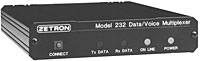 The
Model 232 Data/Voice Multiplexer is an interface device that allows
a person at a desk to have complete access to a radio network that
is located in a distant city, or even in a different country. The
person at the desk
The
Model 232 Data/Voice Multiplexer is an interface device that allows
a person at a desk to have complete access to a radio network that
is located in a distant city, or even in a different country. The
person at the desk