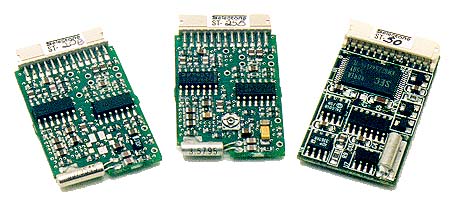
Features
- Three Levels of
Security � suitable for most
secure speech applications.
- Miniature Size
- for easy mounting in most portable and mobile radios.
- High Quality Audio
� input and output audio processing filters provide high
quality, low distortion audio recovery in encrypted mode.
- Fully Compatible
� with nearly all radio systems, including repeaters and trunked
systems.
- Over the Air
Programming (ST-50 series only) �
allows system manager to change code keys or disable lost or
stolen units over the air.
- Full Applications
Support � with detailed installation
instructions for many popular mobile and portable radios.
THREE
LEVELS OF SECURITY
For any voice encryption application,
the level of security required is a function of the sensitivity of
the information being transmitted and the sophistication and
determination of the persons trying to intercept that information.
The Selectone Private Collection features three different
levels of security for a wide range of applications: simple
inversion, rolling code inversion, and time domain digital
encryption. As with all encryption devices, there is a tradeoff
between cost, the level of security and the quality of the recovered
audio.
- Inversion Scrambling
Simple frequency domain inversion scrambling is the most popular
and lowest cost approach to speech security. The cipher process
inverts speech frequencies in reference to one of eight possible
inversion carriers. The scrambled speech is unintelligible to
the casual listener, but the recovered audio is very clear. This
type of encryption is suitable for many business and commercial
applications to discourage eavesdropping from co-channel users
or RF scanners.
- Rolling Code Encryption
The next highest level of encryption is known as frequency
domain rolling code. In this method, the cipher process uses a
proprietary, microprocessor controlled analog scrambling
algorithm with over one trillion available code keys. The
encrypted speech is completely unintelligible, but audio
processing filters provide high quality recovered audio. While
it is possible to "break" an encrypted transmission, to do so
requires sophisticated equipment, knowledgeable technical
personnel, and considerable time. Therefore, rolling code
encryption is suitable for tactical communications typical of
most public safety and more critical commercial applications.
- Time Domain Digital
Encryption
The highest level of security available for conventional, analog
radios is time domain digital encryption. The cipher process
uses Digital Signal Processing (DSP) techniques to produce a
time domain encryption algorithm. The encryption module
digitally records microphone audio for a small time segment. The
segment is then subdivided into smaller blocks within the
segment. The blocks within each segment are then rearranged in
time based on a 72 bit encryption algorithm. The rearranged
blocks are then played back for transmission, with playback
being in a reverse order. Encrypted audio is completely
unintelligible and virtually impossible to break, making time
domain encryption suitable for the most sensitive strategic
communications. Despite the complexity of the encryption, DSP
audio filters provide high quality, low distortion recovered
audio.
ST-20B/C SPEECH INVERSION SCRAMBLER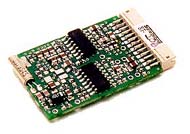
The ST-20B/C is a miniature, low cost
inversion scrambler designed for voice grade communications systems.
Applications include commercial shared repeaters and other business
and marine radio systems where protection is desired from co-channel
users and casual eavesdroppers. The ST-20B/C does not require a
license for export.
The unit measures only 0.9"W X 1.5"L
X 0.18"H for easy mounting in most portable and mobile radios.
Operation is virtually transparent to the user. The Clear/Cipher
input, used to enable or disable the cipher mode, is the only user
control. A choice of eight field-selectable inversion codes allows
compatibility with most commonly used inversion formats.
The standard model for most
applications is the ST-20B. The ST-20C is identical but provides a
low pass filter in parallel to the normal receive audio path. This
path is used for special applications where CTCSS detection must
occur after the application point in the host radio. The following
Motorola radio models require the use of the ST-20C: M1225, P1225,
MT2000 and MT2100.
ST-25B/C ROLLING CODE VOICE ENCRYPTION MODULE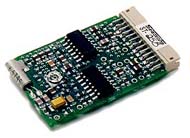
The ST-25B/C Rolling Code Encryption
Module is a miniature, high security voice encryption device
especially designed for tactical communications. Up to four user
programmable code keys, each selected from over four billion
possible keys, may be used to communicate in a secure mode with up
to four different groups on the same radio channel. To maintain
security, code keys are stored in a non-volatile EEPROM and are
never transmitted over the air.
The Clear/Cipher select line is the
only user control. Receive mode is automatic, so that clear speech
or encrypted speech with the proper code key will be received
regardless of the mode selected. Once installed, the ST-25B/C can be
enabled or disabled as required. Therefore, it is not necessary to
equip an entire fleet with encryption, but only those units where
high voice security is required.
Special factory set master code keys
may be reserved to provide extra security for special applications.
Each master code key group has over 268 million possible code keys.
User selectable code keys and other operating parameters are field
programmable with a PC using the ST-25PM Product Manager Software.
The standard model for most
applications is the ST-25B. The ST-25C is identical but provides a
low pass filter in parallel to the normal receive audio path. This
path is used for special applications where CTCSS detection must
occur after the application point in the host radio. Radios which
require the use of the ST-25C are listed above (same as ST-20C). |